
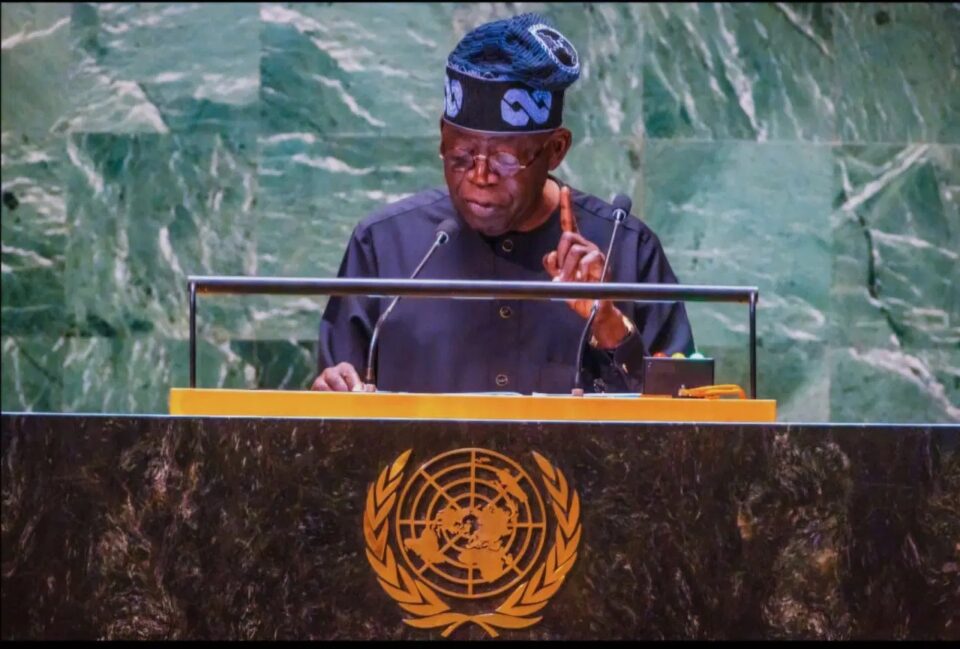
IJEBU — In a robust defense of President Bola Tinubu’s choice to skip the ongoing 81st United Nations General Assembly (UNGA) in New York, diplomatic expert Professor Femi Otubanjo has asserted that the global summit is “not so important” when weighed against national interests and a president’s scheduled annual leave.
Speaking on Tuesday as a guest on Frontline, a current affairs programme on Eagle 102.5 FM, Ilese-Ijebu, the Research Professor at the Nigerian Institute of International Affairs (NIIA) argued that much of the public criticism surrounding the President’s absence lacks proper diplomatic context and fails to recognize the legitimacy of delegating state duties.
Otubanjo emphasized that the primary metric for assessing Nigeria’s involvement in international diplomacy should be effective representation rather than the physical attendance of the Head of State. He noted that Vice President Kashim Shettima’s presence at the helm of the Nigerian delegation ensures the country remains actively engaged at the highest levels of governance.
The professor urged critics to remember that President Tinubu is currently taking his statutory annual leave, during which constitutional mechanisms exist specifically to allow the Vice President and cabinet officials to manage state affairs smoothly, including high-level international representation.
Dismissing the widespread notion that physical presence at UNGA is an indispensable foreign policy mandate, Otubanjo described the annual gathering in New York as merely one of many tools in standard diplomatic practice. He argued that missing the event does not diminish a country’s capacity to execute sound foreign policy.
Addressing the nature of high-level engagements at such summits, Otubanjo questioned the true substance of briefly scheduled international encounters. He noted that brief, five-to-ten-minute exchanges between heads of state often consist of polite formalities and photo opportunities rather than actionable working sessions.
The veteran scholar stressed that substantive diplomatic work takes place outside noisy convention halls. Meaningful bilateral treaties, economic partnerships, and strategic alliances, he explained, are forged through dedicated bilateral channels and sustained ambassadorial negotiations rather than brief international summits.
Highlighting the evolution of global diplomacy, Otubanjo pointed to the structural shifts brought on by the COVID-19 pandemic, which permanently demonstrated that world leaders can successfully direct foreign engagements, hold strategic consultations, and manage governance remotely using modern communication technologies.
President Tinubu had departed Nigeria on August 30 for London to begin a three-week annual vacation before proceeding to Paris for bilateral discussions with French President Emmanuel Macron and business executive Vincent Bolloré. The Presidency recently announced a brief extension to his working vacation, confirming his expected return home over the weekend.
Despite official assurances that the President remains in constant control of state affairs, his repeated absence from UNGA has sparked intense domestic political debate. Political opposition figures, including former Vice President Atiku Abubakar, have argued that three consecutive years of delegating UNGA attendance to the Vice President dilutes Nigeria’s global executive visibility.
The Federal Government, however, maintains that Vice President Shettima carries the full, undivided mandate of the Nigerian state to lead the delegation. Shettima, who arrived in New York on Sunday, is scheduled to deliver Nigeria’s national statement and participate in crucial side events focusing on climate finance, sustainable development, and global institutional reform.
Broadening his critique beyond international policy, Otubanjo argued that a country’s global reputation is fundamentally rooted in its domestic reality. He stated firmly that no country can project strength or respect abroad while battling governance failures and mismanagement at home.
The professor called for an urgent “domestic reset” centered on transparency, accountability, and fiscal discipline. In an increasingly interconnected world where internal governance is visible to all, he stressed that Nigeria’s international standing relies heavily on its internal administration and how it manages public resources.
Otubanjo expressed concern over public expenditure priorities, pointing directly to controversial government spending such as $150 million for a presidential aircraft, ₦21 billion for the Vice President’s official residence, and ₦90 billion allocated to sponsor religious pilgrimages. He argued that such spending sends poor signals both to citizens and the international community.
Concluding his foreign policy assessment, Otubanjo declared that Nigeria’s grand ambitions—such as leading West Africa, influencing the African Union, and securing a permanent seat on a reformed UN Security Council—must be backed by disciplined governance at home. Without structural domestic reforms, he warned, diplomatic representation anywhere in the world will yield limited results.
