
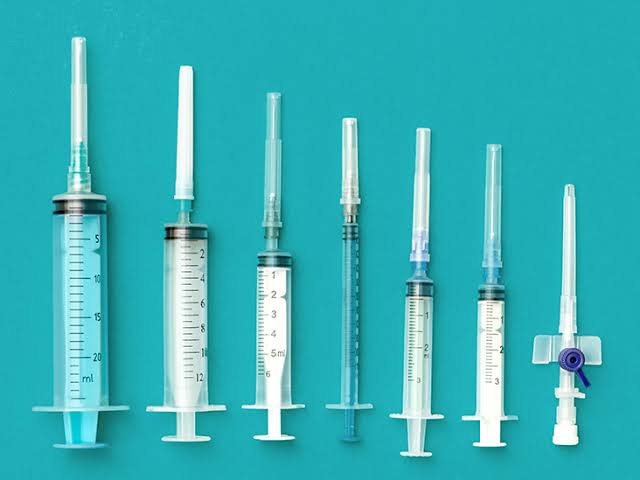
ABEOKUTA–Medical equipments over time, has been a very important items in the health sector, especially with the outbreak of the covid-19 pandemic, it became more critical.
One of the most used and important item by medical practitioners is the Synrige, as it’s use cut across all medical practice
A syringe, according to Wikipedia is a simple reciprocating pump consisting of a plunger (though in modern syringes, it is actually a piston) that fits tightly within a cylindrical tube called a barrel.
The plunger can be linearly pulled and pushed along the inside of the tube, allowing the syringe to take in and expel liquid or gas through a discharge orifice at the front (open) end of the tube.
The open end of the syringe may be fitted with a hypodermic needle, a nozzle or tubing to direct the flow into and out of the barrel. Syringes are frequently used in clinical medicine to administer injections, infuse intravenous therapy into the bloodstream, apply compounds such as glue or lubricant, and draw/measure liquids.
However, in recent times the quality of this ‘most’ important medical equipment has been a subject of discussion in Nigeria, owing to the seamless importation of the item from foreign countries especially the Peoples Republic of China.
The importation of synrige through land, air and sea borders into the country has been shrouded with several corrupt practises which overtime has rendered the local production useless, thereby putting the Nigeria foreign exchange in fuss.
More importantly, most of the imported syringe has been found to be of low quality compare to what it is obtainable locally.
Findings reveals that, most of the company involve in the production and importation of synrige into the country uses few quality of the product to obtain NAFDAC number, which they often jettison with low quality or fake ones bearing the already obtained NAFDAC number.
The results of such act is better imagined than seen.
A case study is of one Miss Onen Beatrice (not real name), who has been rendered handicap with one leg short of the other through the use of fake synrige imported into the country to administer her injection.
Miss Beatrice who before the said event, was full of life with tremendous ambition to use her legs in using the sewing machine to create artistry. Those lofty ideas and ambition was cut short because of the corrupt and sharp practises of some Nigerians who allowed the fake and low quality synrige into the country, and being used on her.
As at 2017, the Manufacturer Association of Nigeria (MAN) had advocated for a lower tarriff of 5 percent cumulative on the importation of raw materials for making syringes and needles in a bid to encourage local manufacturers of medical devices in the country.
The association also requested for 20 percent duty on finished syringes and 50 percent Import Adjustment Tax (IAT) to discourage importation of finished syringe and needles, to boost local production of the devices in line with the backward integration policy and patronage of made-in-Nigeria goods directive of government.
But contrary to this, information has it that the local companies pays 35 percent cumulative duty, VAT and Levy on imported raw materials to produce syringe and needle but in the same country, those syringes and needles are imported at 5 percent duty, 0 percent VAT and 0 percent Levy. That is unfair and does not encourage local manufacturing.
Even where imported syringes are not substandard and there is need to give import permit or licence, import duty on syringes should be increased to 40 percent minimum in order to discourage indiscriminate importation since there are local industries producing standard disposable syringes and other medical necessaries in the country.
Reports of increasing dumping of imported Asian products, including disposable syringes, many of which are substandard and which are even purportedly subsidized by their home governments, into Nigeria are worrisome. The Ministry of Health, NAFDAC and other relevant agencies of government should weigh in and do the needful to save local productions.
If nothing is done, it will be increasingly difficult, if not impossible, for companies producing syringes and medical devices in the country such as Zaria Pharmaceutical Limited (Zarinject), El-Salmat Pharmaceuticals in Ilorin, First Medicals and Sterile Products in Calabar, PAHF AD Syringe Manufacturer in Port Harcourt, Jubilee synrige in Akwa Ibom among others, to keep afloat.
The supervising authorities in the health sector would do well to deliberately intervene to protect Nigerian syringe/medical device industries from, what stakeholders call, unfair competition by foreign manufacturers.
There is no doubt that this deliberate encouragement of local industries through a protectionist policy that, for instance, makes importation very rigorous will help to strength local capacities, generate employment for the unemployed youths, reduce over-dependence on imported products, conserve foreign exchange which the economy can leverage on, and bring about easier monitoring and control of standards.
Standard control is key. If reports that substandard imported syringes in the Nigerian markets break easily at the point of using them for injections on patients are true, then it should be a source of serious concern to well-meaning Nigerians.
Why allow importation of syringes when Nigerian companies, which have World Health Organisation (WHO), NAFDAC, Pharmacist Council of Nigeria and International Organisation for Standardisation (ISO)/Standard Organisation of Nigeria (SON) certifications, are producing standard syringes and other medical devices in the country, and are even coping with the pressure of market demands? Health supervisory authorities should take necessary actions.
The Director General, National Agency for Food and Drug Administration and Control (NAFDAC), Prof. Mojisola Adeyeye when contacted said that Nigerians should have a rethink when buying anything from outside the country, adding that most of those products are not in anyway better than what is produced locally.
“It is like all of us are responsible for what is happening to us as a country. Nobody can absorb him or herself, we are all responsible for this”
“We like things that are manufactured overseas. We still have a neo-colonialism mentality saying if it is manufactured in Nigeria they don’t like it.
“Even we don’t have confidence in ourselves.
“Sometimes we don’t blame people we should be proud of what we can make. It doesn’t mean we will be perfect Over night. That was what China did and China is leading the world market today”
She further reteraites that the agency is aware of the sharp practises associated with the influx of low quality synrige in the country, while stressing that NAFDAC is doing it’s best to contain the menace.
“They (importers) give us idle information, but we will wait for them at the post marketing level, meaning when they start selling to the people, we wait for them there. We also put such companies into high risk categories and we will be de-registering them”
“The prospect is warning and if they can redo whatever they are doing, it’s fine. But If they cannot, we are going to delete them”
Prof. Adeyeye however advice local producers of synrige and other medical equipment to approach the agency for partnership, adding that NAFDAC would encourage local producers by all means.
“It is a matter of us knowing we can do it and dialogue with NAFDAC right from the beginning because we cannot allow sub-standard medicine or medical device to be made or imported into the country”
“We are going to sign African Continental Medical Trade Agreement very soon and country’s will be bringing things to us and we are the largest continent trading pool in Africa so many countries will be coming to us”
The Cross River State Commissioner for Health, Dr. Betta Edu speaking on the menace suggest that there is need for proper regulation of the sector.
She made it clear the government should be very concerns about everything that is coming into the country.
Dr. Edu also emphasized that as a matter of policy in encouraging the local content, there is need for all government procurement of medical equipments to be more of local productions.
“Ordinarily, it is easy for us in Nigeria to assume that everything that comes from other countries are okay and good for consumption without knowing that they might even be worse off than what is produced in Nigeria”
“For me, I would say no matter where it is being produced, the right thing must be done always”
“We can rather use other methods to improve local production by giving them tax relieve when setting up local industries, especially with what the Governor of Cross River State is doing”
Dr. Edidiong Akpan, a Medical Doctor in Uyo berates the government in quality control, saying that most of the time the initial check on most of the products usual met the require specification.
However, subsequent check on same products are lacking, adding that some Nigerians even go behind the market and pay their way out.
He however call on government agencies responsible for the regulation to step up their game, and desist from witch-hunting local producers to the detriment of the economy
For emphasy, there is need to reduce the cost of raw materials for the production of the medical devices to encourage indigenous companies to produce locally and create jobs for our teaming youths, rather than paying high import duty where as finished products are imported at very low duty.
Although, it is commendable that the federal government introduced ease of doing business in Nigeria but if the environment is more conducive and welcoming, many more investors will venture into syringe manufacturing.
